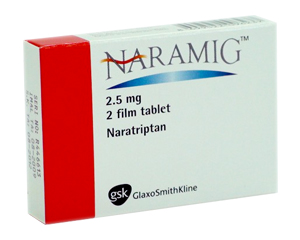

Naratriptan
Incl. online consultation, medicine and discreet delivery
View Options
The medical information on this site is provided for educational purposes. It does not replace a face-to-face consultation with your GP or specialist. Always follow the advice of your prescribing doctor and read the patient information leaflet supplied with your medication.
Choose Your Medicine
Select dosage and quantity
Online Consultation
Reviewed by a qualified physician
Fast, Discreet Delivery
Delivered to your door
Medical Information
About This Medicine
Naratriptan is a selective serotonin (5-HT1) receptor agonist, commonly known as a triptan, used for the acute treatment of migraine attacks with or without aura.
It is taken at the onset of migraine headache to relieve pain, nausea, sensitivity to light, and sensitivity to sound.
Naratriptan is not intended for migraine prevention and should not be used for other types of headache.
Naratriptan works by narrowing dilated blood vessels in the brain and inhibiting the release of neuropeptides involved in the inflammatory cascade of migraine.
It also interrupts pain signal transmission in the trigeminal nerve pathways.
Compared to some other triptans, naratriptan has a slower onset of action but a longer half-life, which may translate into a lower rate of headache recurrence within the same attack.
Naratriptan is taken as soon as the headache phase of a migraine begins. Taking it during the aura phase before headache onset is less effective.
If the first dose provides relief but symptoms return, a second dose may be taken after four hours, up to a maximum of two doses in 24 hours.
Usage & Dosage
Take one 2.5 mg tablet at the onset of the migraine headache, swallowed whole with water. It may be taken with or without food.
If the headache improves but then returns, a second tablet may be taken no sooner than four hours after the first.
If the first dose has no effect at all, do not take a second dose for the same attack.
Do not use naratriptan on more than two days per week on a regular basis, as overuse may lead to medication-overuse headache, which can worsen your overall headache pattern.
The recommended dose is 2.5 mg taken at the onset of migraine headache. A second 2.5 mg dose may be taken after four hours if symptoms return. The maximum dose in 24 hours is 5 mg (two tablets).
In patients with mild to moderate renal or hepatic impairment, the maximum dose is 2.5 mg in 24 hours. Naratriptan is not recommended in severe renal or hepatic impairment.
Side Effects
Common side effects (up to 1 in 10 users) include sensations of tingling, warmth, heaviness, or pressure in various parts of the body (including the chest and throat), drowsiness, dizziness, and nausea.
These effects are usually mild and transient. Uncommon effects include fatigue, visual disturbance, and palpitations.
Chest tightness or pressure is common with triptans and is usually non-cardiac, but any severe or persistent chest pain should be reported immediately.
Rare effects include coronary vasospasm, arrhythmias, and serotonin syndrome when combined with certain medications.
Warnings & Precautions
Naratriptan should not be taken within 24 hours of using another triptan or an ergotamine-containing medication.
It is not suitable for patients with significant cardiovascular disease, uncontrolled hypertension, or a history of stroke or transient ischaemic attack.
The first dose in patients with cardiovascular risk factors may be administered under medical supervision. Avoid overuse to prevent medication-overuse headache.
If you experience an increase in migraine frequency while using naratriptan regularly, consult your prescriber.
Contraindications
Naratriptan is contraindicated in patients with a history of ischaemic heart disease, coronary artery vasospasm, peripheral vascular disease, previous stroke or transient ischaemic attack, uncontrolled hypertension, severe renal or hepatic impairment, and hypersensitivity to naratriptan or any excipient.
It must not be used concurrently with other triptans or ergot-containing medications.