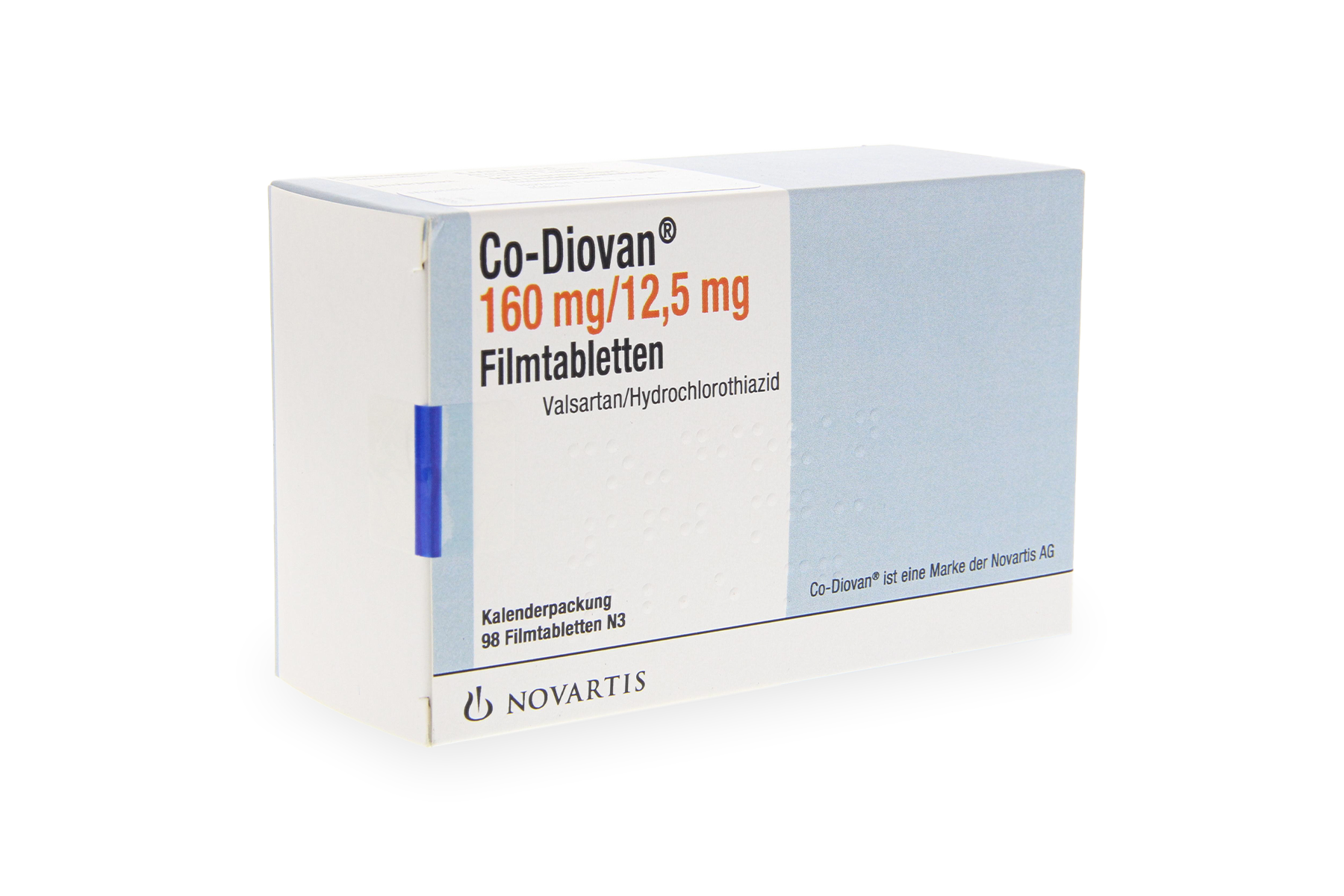
Co-Diovan
Incl. online consultation, medicine and discreet delivery
View Options
The medical information on this site is provided for educational purposes. It does not replace a face-to-face consultation with your GP or specialist. Always follow the advice of your prescribing doctor and read the patient information leaflet supplied with your medication.
Choose Your Medicine
Select dosage and quantity
Online Consultation
Reviewed by a qualified physician
Fast, Discreet Delivery
Delivered to your door
Medical Information
About This Medicine
Co-Diovan is a fixed-dose combination tablet containing valsartan, an angiotensin II receptor blocker (ARB), and hydrochlorothiazide, a thiazide diuretic.
It is prescribed for the treatment of essential hypertension in adults whose blood pressure is not adequately controlled by either agent used alone.
Valsartan selectively blocks the angiotensin II type 1 (AT1) receptor, preventing the vasoconstrictor and aldosterone-secreting effects of angiotensin II.
This results in vasodilation, reduced sodium and water retention, and lower blood pressure.
Hydrochlorothiazide acts on the distal convoluted tubule of the kidney to inhibit sodium and chloride reabsorption, promoting diuresis and reducing blood volume.
The complementary mechanisms of these two agents produce an additive antihypertensive effect.
The combination of an ARB with a thiazide diuretic is a well-established approach in hypertension management.
The ARB component also helps to counteract the reflex activation of the renin-angiotensin system that occurs with diuretic-induced volume depletion, while the diuretic component enhances the blood pressure-lowering efficacy of the ARB.
Usage & Dosage
Take one Co-Diovan tablet by mouth once daily, with or without food. Swallow with a glass of water. It is best to take it at the same time each day, preferably in the morning.
Continue treatment even if you feel well, as hypertension typically has no symptoms.
Adequate fluid intake should be maintained, particularly in hot weather or during exercise, to reduce the risk of dehydration.
Co-Diovan is available in several strengths: 80/12.5 mg, 160/12.5 mg, 160/25 mg, and 320/12.5 mg, and 320/25 mg (valsartan/hydrochlorothiazide).
The dose is individualised based on blood pressure response. The usual starting combination is 80/12.5 mg or 160/12.5 mg once daily. The maximum recommended dose is 320/25 mg once daily.
Dose adjustments may be required in patients with hepatic or renal impairment.
Side Effects
Common (1 in 10 to 1 in 100): dizziness, headache, fatigue, nasopharyngitis.
Uncommon (1 in 100 to 1 in 1,000): hypotension, postural dizziness, cough, nausea, diarrhoea, myalgia, hypokalaemia, hyperuricaemia.
Rare (1 in 1,000 to 1 in 10,000): angioedema, renal impairment, elevated liver enzymes, photosensitivity reaction.
Very rare (less than 1 in 10,000): thrombocytopenia, vasculitis, metabolic alkalosis.
Seek medical attention if you experience swelling of the face, lips, tongue, or throat, as this may indicate angioedema.
Warnings & Precautions
Dual blockade of the renin-angiotensin system (combining an ACE inhibitor, ARB, and/or direct renin inhibitor) is not recommended due to the increased risk of hypotension, hyperkalaemia, and renal impairment.
Hydrochlorothiazide may cause electrolyte disturbances, particularly hypokalaemia and hyponatraemia; regular monitoring is advised.
Volume-depleted patients may experience symptomatic hypotension; correct dehydration before starting treatment. Patients with renal artery stenosis may develop deterioration of renal function.
Hydrochlorothiazide may impair glucose tolerance and raise uric acid levels.
Contraindications
Co-Diovan is contraindicated in patients with severe hepatic impairment, biliary cirrhosis, cholestasis, anuria, severe renal impairment (creatinine clearance below 30 ml/min), refractory hypokalaemia or hyponatraemia, symptomatic hyperuricaemia, and during pregnancy (particularly the second and third trimesters).
It must not be co-administered with aliskiren in patients with diabetes or renal impairment.