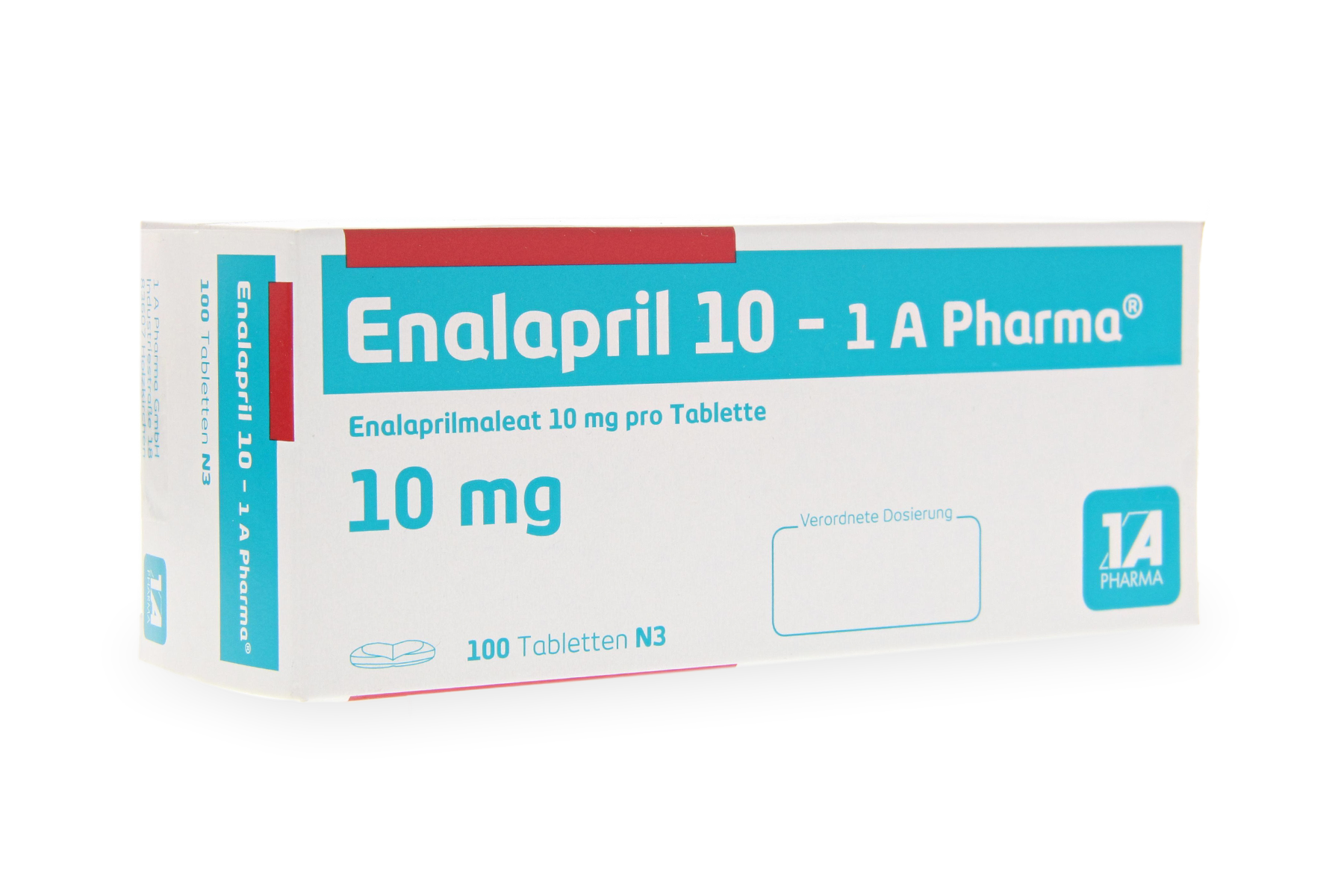
Enalapril
Incl. online consultation, medicine and discreet delivery
View Options
The medical information on this site is provided for educational purposes. It does not replace a face-to-face consultation with your GP or specialist. Always follow the advice of your prescribing doctor and read the patient information leaflet supplied with your medication.
Choose Your Medicine
Select dosage and quantity
Online Consultation
Reviewed by a qualified physician
Fast, Discreet Delivery
Delivered to your door
Medical Information
About This Medicine
Enalapril is an ACE inhibitor (angiotensin-converting enzyme inhibitor). It blocks an enzyme that turns angiotensin I into angiotensin II.
Angiotensin II is a strong vasoconstrictor, which means it narrows your blood vessels. Enalapril also stops the body from breaking down bradykinin.
Together, these actions relax and widen your blood vessels. They also lower aldosterone, a hormone that makes your body hold on to sodium and water. As a result, your body keeps less salt and water.
Over time, enalapril can also reverse harmful changes in the heart muscle. Enalapril is a prodrug. This means the liver changes it into its active form, enalaprilat.
Doctors prescribe enalapril for high blood pressure (essential hypertension) and for heart failure of all grades.
It can also prevent heart failure symptoms in people with weak left ventricle function who feel no symptoms yet.
Two key studies, SOLVD and CONSENSUS, showed that enalapril lowers the risk of death and hospital stays in heart failure.
NICE recommends ACE inhibitors, including enalapril, as a first-choice treatment for heart failure with a reduced ejection fraction.
NICE also recommends them as a first-choice blood pressure treatment for people under 55 years who are not of African or Caribbean descent.
Enalapril usually reaches its full effect on blood pressure within 1-2 weeks. It has a strong evidence base built over more than 40 years of use.
Usage & Dosage
Take enalapril once or twice daily, depending on why you take it. Take it at the same time each day, with or without food. Swallow the tablets whole with water.
For high blood pressure, once a day is usually enough. For heart failure, twice a day is standard. Keep taking enalapril even when you feel well. Do not stop suddenly without medical advice.
Drink enough fluids, especially in hot weather, during illness, or when you exercise.
Tell your doctor straight away if you have a lasting dry cough, swelling of the face or tongue, or trouble breathing. These can be signs of angioedema, a rare but serious side effect.
Your blood pressure may drop after the first dose. This is more likely if you are low on fluids. For this reason, the first dose is often taken at bedtime.
Hypertension: Start at 5 mg once daily. The usual maintenance dose is 10-20 mg once daily. The maximum is 40 mg daily. If you take diuretics (water tablets), start at 2.
5 mg, because the risk of low blood pressure is higher.
Heart failure: Start at 2.5 mg once daily. Build up the dose slowly over 2-4 weeks to a target of 10-20 mg twice daily, as you can tolerate it.
Your doctor checks your kidney function and potassium each time the dose goes up.
Asymptomatic LV dysfunction: Start at 2.5 mg twice daily. Build up to 10 mg twice daily.
In reduced kidney function (eGFR 30-60 mL/min), start at 2.5 mg daily and increase the dose carefully. If eGFR is below 30, a specialist should oversee treatment.
Older people should start at lower doses with close monitoring.
Side Effects
Side effects are grouped below by how often they happen, following SmPC frequency categories.
Very common (≥1/10): Dizziness and a dry, lasting cough that does not bring up mucus. This cough affects 5-20% of patients. It is the most common reason people stop the medicine.
Common (≥1/100 to <1/10): Headache, low mood, low blood pressure (after the first dose and on standing), fainting, nausea, diarrhoea, tiredness, weakness, blurred vision, rash, high potassium (hyperkalaemia), and reduced kidney function.
Uncommon (≥1/1,000 to <1/100): Angioedema (0.1-0.
7%, more common in patients of African descent), changes in taste, trouble sleeping, drowsiness, tingling, vertigo, fast heartbeat, palpitations, tummy pain, muscle pain, and muscle cramps.
Rare (≥1/10,000 to <1/1,000): Hepatitis, jaundice, pancreatitis, Stevens-Johnson syndrome, pemphigus, low neutrophils (neutropenia), agranulocytosis, low platelets (thrombocytopenia), and anaemia.
The dry cough happens because bradykinin builds up. This effect is shared by all ACE inhibitors. Switching to an ARB usually clears the cough.
Warnings & Precautions
Your blood pressure may drop after the first dose. This is more likely if you are low on fluids. That includes people on diuretics, on a low-salt diet, on dialysis, or with diarrhoea or vomiting.
Your doctor may give the first dose at bedtime. If possible, your doctor may stop diuretics 2-3 days before you start. Angioedema can happen at any point during treatment.
It can be life-threatening if it affects the tongue, glottis, or larynx (parts of the throat and voice box). If this happens, stop the medicine at once and get emergency care.
The risk is higher in patients of African descent. Your doctor checks your kidney function and potassium within 1-2 weeks of starting, and after each dose change.
Do not use two RAAS-blocking medicines together (ONTARGET data). ACE inhibitors can harm an unborn baby, so they must not be used in pregnancy.
In the second and third trimesters, they cause kidney failure and skull defects in the baby. Stop the medicine at once if you find out you are pregnant.
Contraindications
Do not take enalapril if any of the following apply to you. You are allergic to enalapril, to other ACE inhibitors, or to any ingredient in the tablet.
You have a history of angioedema, whether inherited or caused by an ACE inhibitor. You are in the second or third trimester of pregnancy.
You have narrowing in the arteries to both kidneys (bilateral renal artery stenosis). You also take aliskiren and you have diabetes or an eGFR below 60 mL/min/1.73m².
Do not take sacubitril/valsartan within 36 hours of your last enalapril dose, as this raises the risk of angioedema.
Frequently Asked Questions
Why does enalapril cause a dry cough?
Can enalapril protect my kidneys?
What is first-dose hypotension?
Is enalapril safe in pregnancy?
Can I take enalapril with potassium supplements?
Related articles: Enalapril
Enalapril side effects: a detailed patient guide
Enalapril is an ACE inhibitor used for high blood pressure and heart failure. The most characteristic side effect is a persistent dry cough, affecting up to 15% of patients. Other common effects include dizziness, headache and fatigue. Rare but serious side effects include angioedema and hyperkalaemia. Most side effects are manageable and dose-related.
nhs-infoEnalapril NHS: your complete patient guide
Enalapril is an ACE inhibitor available on the NHS for high blood pressure, heart failure and diabetic kidney disease. Usual doses range from 5 to 40 mg daily. It requires regular blood tests to monitor kidney function and potassium. The most common side effect is a dry cough, which affects about 1 in 10 patients.