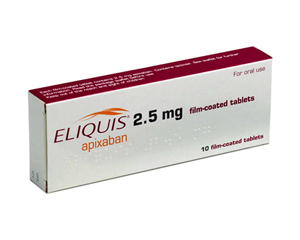
Eliquis
Incl. online consultation, medicine and discreet delivery
View Options
The medical information on this site is provided for educational purposes. It does not replace a face-to-face consultation with your GP or specialist. Always follow the advice of your prescribing doctor and read the patient information leaflet supplied with your medication.
Choose Your Medicine
Select dosage and quantity
Online Consultation
Reviewed by a qualified physician
Fast, Discreet Delivery
Delivered to your door
Medical Information
About This Medicine
Eliquis contains apixaban, a direct oral anticoagulant (DOAC) that selectively inhibits Factor Xa, a key enzyme in the blood coagulation cascade.
It is prescribed for the prevention of stroke and systemic embolism in patients with non-valvular atrial fibrillation, the treatment and prevention of deep vein thrombosis (DVT) and pulmonary embolism (PE), and the prevention of venous thromboembolism following elective hip or knee replacement surgery.
Apixaban works by directly and reversibly binding to the active site of Factor Xa, both free and clot-bound, without requiring antithrombin III as a cofactor.
By inhibiting Factor Xa, apixaban reduces thrombin generation and clot formation.
Unlike warfarin, it has a predictable pharmacokinetic profile that does not require routine anticoagulation monitoring or frequent dose adjustments.
Clinical trials, including the landmark ARISTOTLE study, have demonstrated that apixaban is at least as effective as warfarin in preventing stroke in atrial fibrillation, whilst causing significantly fewer major bleeds and intracranial haemorrhages.
This favourable risk-benefit profile has made Eliquis one of the most widely prescribed anticoagulants worldwide.
Usage & Dosage
Take Eliquis twice daily, approximately 12 hours apart, with or without food. Swallow the tablet whole with water.
If you are unable to swallow tablets, Eliquis may be crushed and suspended in water, apple juice, or mixed with apple puree and administered immediately.
Do not stop taking Eliquis without consulting your prescriber, as abrupt discontinuation increases the risk of thrombotic events.
If you miss a dose, take it as soon as you remember and then resume twice-daily dosing; do not take a double dose.
For stroke prevention in atrial fibrillation: 5 mg twice daily. A reduced dose of 2.
5 mg twice daily is recommended if the patient has at least two of the following: age 80 years or older, body weight 60 kg or less, or serum creatinine 133 micromol/L or higher.
For DVT/PE treatment: 10 mg twice daily for the first 7 days, then 5 mg twice daily. For prevention of recurrence: 2.5 mg twice daily. For VTE prophylaxis after hip or knee surgery: 2.
5 mg twice daily for 32 to 38 days (hip) or 10 to 14 days (knee).
Side Effects
Common (1 in 10 to 1 in 100): bleeding (including haematoma, epistaxis, haematuria, gingival bleeding, gastrointestinal bleeding), bruising, anaemia, nausea.
Uncommon (1 in 100 to 1 in 1,000): hypotension, haemoptysis, rectal bleeding, haemorrhoidal bleeding, elevated liver enzymes, hypersensitivity, skin rash, pruritus.
Rare (1 in 1,000 to 1 in 10,000): intracranial haemorrhage, intraocular bleeding, retroperitoneal haemorrhage. As with all anticoagulants, the principal risk of apixaban is bleeding.
Seek immediate medical attention for any signs of significant or uncontrolled bleeding.
Warnings & Precautions
Inform all healthcare providers, including dentists, that you are taking Eliquis. Carry an anticoagulant alert card.
Be aware that bleeding risk is increased if Eliquis is combined with other anticoagulants, antiplatelet agents, or NSAIDs.
Use with caution in patients with moderate hepatic impairment, renal impairment, or conditions that predispose to bleeding. Do not use in patients with prosthetic heart valves.
A specific reversal agent (andexanet alfa) is available for life-threatening bleeding situations.
Contraindications
Eliquis is contraindicated in patients with active clinically significant bleeding, hepatic disease associated with coagulopathy and clinically relevant bleeding risk, lesions at risk of clinically significant bleeding (such as recent cerebral infarction), and hypersensitivity to apixaban or any excipient.
Concomitant treatment with other anticoagulants is contraindicated except during switching periods.
Frequently Asked Questions
Do I need regular blood tests with Eliquis?
What should I do if I cut myself while taking Eliquis?
Can I take Eliquis with aspirin?
What happens if I miss a dose of Eliquis?
Can I eat green vegetables while taking Eliquis?
Related articles: Eliquis
Eliquis (apixaban) side effects: what you need to know
Eliquis (apixaban) is a direct oral anticoagulant (DOAC) used to prevent and treat blood clots. The most important side effect is bleeding, which can range from minor bruising to serious internal haemorrhage. Understanding the warning signs of significant bleeding is essential for anyone taking this medicine.
dosageEliquis (apixaban) dosage guide: getting the dose right
Eliquis (apixaban) is taken as a tablet twice daily. The standard dose is 5 mg twice daily for atrial fibrillation, with a reduced dose of 2.5 mg twice daily for certain higher-risk patients. Different doses apply for the treatment and prevention of deep vein thrombosis and pulmonary embolism. Getting the dose right is essential for both safety and effectiveness.