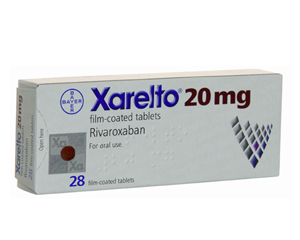
Xarelto
Incl. online consultation, medicine and discreet delivery
View Options
The medical information on this site is provided for educational purposes. It does not replace a face-to-face consultation with your GP or specialist. Always follow the advice of your prescribing doctor and read the patient information leaflet supplied with your medication.
Choose Your Medicine
Select dosage and quantity
Online Consultation
Reviewed by a qualified physician
Fast, Discreet Delivery
Delivered to your door
Medical Information
About This Medicine
Xarelto contains rivaroxaban, a direct oral anticoagulant (DOAC) that selectively inhibits Factor Xa.
It is prescribed for the prevention of stroke and systemic embolism in adults with non-valvular atrial fibrillation, the treatment and secondary prevention of deep vein thrombosis and pulmonary embolism, and the prevention of venous thromboembolism following elective hip or knee replacement surgery.
It is also approved for use with antiplatelet therapy in patients with coronary artery disease or peripheral arterial disease.
Rivaroxaban works by directly and selectively inhibiting free and clot-bound Factor Xa, a pivotal enzyme in the coagulation cascade that converts prothrombin to thrombin.
By reducing thrombin generation, rivaroxaban prevents the formation of fibrin clots. It offers predictable pharmacokinetics, allowing for fixed dosing without routine laboratory monitoring.
Xarelto has been studied in one of the largest clinical trial programmes in modern cardiology, including the ROCKET AF, EINSTEIN, and COMPASS trials.
These studies established its efficacy and safety across a broad range of thromboembolic conditions, securing its place as a widely used alternative to warfarin in clinical practice.
Usage & Dosage
Take Xarelto with food (for doses of 15 mg and above) to ensure optimal absorption. The 10 mg dose may be taken with or without food. Swallow the tablet whole with water.
Take it at approximately the same time each day. Do not stop treatment without consulting your prescriber, as discontinuation increases the risk of thrombotic events.
If you have difficulty swallowing, Xarelto tablets may be crushed and mixed with water or apple puree immediately before use.
For stroke prevention in atrial fibrillation: 20 mg once daily (15 mg in patients with moderate to severe renal impairment, CrCl 15-49 ml/min).
For DVT/PE treatment: 15 mg twice daily for the first 21 days, then 20 mg once daily. For prevention of recurrent DVT/PE: 10 mg once daily after at least 6 months of treatment.
For VTE prophylaxis after surgery: 10 mg once daily for 35 days (hip) or 12 days (knee). Xarelto is not recommended if CrCl is below 15 ml/min.
Side Effects
Common (1 in 10 to 1 in 100): bleeding (including epistaxis, gingival bleeding, gastrointestinal bleeding, haematuria, genital tract bleeding), anaemia, bruising, dizziness, headache, nausea, constipation, diarrhoea, abdominal pain, elevated transaminases, post-procedural haemorrhage.
Uncommon (1 in 100 to 1 in 1,000): tachycardia, hypotension, dry mouth, hepatic dysfunction, urticaria, pruritus, peripheral oedema, malaise.
Rare (1 in 1,000 to 1 in 10,000): jaundice, intracranial haemorrhage, retroperitoneal bleeding, compartment syndrome following haemorrhage.
As with all anticoagulants, bleeding is the primary risk.
Warnings & Precautions
All healthcare providers, including dentists, must be informed that you take Xarelto. Carry an anticoagulant alert card at all times.
The risk of bleeding is increased when Xarelto is used alongside NSAIDs, antiplatelet agents, or other anticoagulants.
Use with caution in patients with moderate hepatic impairment, renal impairment, or conditions predisposing to bleeding. Do not use in patients with prosthetic heart valves requiring anticoagulation.
There is no widely available specific reversal agent; andexanet alfa has received approval in some jurisdictions.
Contraindications
Xarelto is contraindicated in patients with active clinically significant bleeding, hepatic disease associated with coagulopathy and clinically relevant bleeding risk, pregnancy and breastfeeding, and hypersensitivity to rivaroxaban or any excipient.
Co-administration with strong inhibitors of both CYP3A4 and P-glycoprotein (such as ketoconazole, ritonavir, or itraconazole) should be avoided.
Not recommended in severe renal impairment (CrCl below 15 ml/min).