Synalar
Incl. online consultation, medicine and discreet delivery
View Options
The medical information on this site is provided for educational purposes. It does not replace a face-to-face consultation with your GP or specialist. Always follow the advice of your prescribing doctor and read the patient information leaflet supplied with your medication.
Choose Your Medicine
Select dosage and quantity
Online Consultation
Reviewed by a qualified physician
Fast, Discreet Delivery
Delivered to your door
Medical Information
About This Medicine
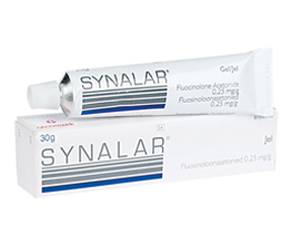
Synalar contains fluocinolone acetonide. This is a potent topical corticosteroid, a strong anti-inflammatory medicine you put on the skin.
It treats severe skin inflammation that has not improved with milder creams.
Doctors prescribe it for conditions such as severe eczema, psoriasis, discoid lupus erythematosus, and other steroid-responsive dermatoses (skin problems that respond to steroids).
Fluocinolone acetonide works by binding to glucocorticoid receptors inside your skin cells. It then calms the immune system in several ways.
It lowers the chemical messengers that drive inflammation, called pro-inflammatory cytokines. It blocks an enzyme called phospholipase A2.
It also stops white blood cells (leucocytes) from moving to the inflamed area. The result is much less redness, swelling, itching, and scaling.
Synalar is a potent (Group III) topical corticosteroid. Potent corticosteroids are kept for skin that does not respond to mild or moderate creams.
With long-term use they carry a higher risk of side effects, both on the skin and in the body. A prescriber who is experienced in skin care should supervise their use.
Synalar comes as a cream, an ointment, and a gel. The cream suits moist or weeping areas. The ointment suits dry, thickened skin. The gel suits hairy areas such as the scalp.
Usage & Dosage
Apply a thin layer of Synalar to the affected area once or twice daily, as your prescriber directs. Rub the cream, ointment, or gel gently into the skin.
Wash your hands after use, unless your hands are the area being treated.
Use the smallest amount you need, for the shortest time that controls your symptoms. Once the condition improves, switch to a milder corticosteroid or an emollient (a moisturiser) for upkeep.
Do not apply it to the face, the armpits (axillae), or the groin for more than five to seven days, unless your prescriber tells you to.
Do not use Synalar under airtight (occlusive) dressings unless your dermatologist directs it. Covering the skin this way raises how much medicine is absorbed and the risk of side effects.
Apply a thin layer once or twice daily. For adults, treatment on the body should not usually last more than two to four weeks without a dermatological review.
On the face and skin folds (flexures), do not treat for more than five to seven days.
Children should only use potent topical corticosteroids under specialist supervision. Use them for the shortest possible time and at the lowest amount that works.
The fingertip unit method can help you measure the right amount.
Side Effects
Skin thinning (atrophy) is the most important local side effect. It can start after as little as two to three weeks of continuous use on sensitive areas.
Stretch marks (striae), tiny visible blood vessels (telangiectasia), and bruising (purpura) may follow long use.
Using potent corticosteroids on the face for long periods can cause a rash around the mouth (perioral dermatitis), steroid rosacea, and acne-like spots (acneiform eruptions).
The skin may also lose colour (hypopigmentation), most often in darker skin tones.
An allergic skin reaction (contact dermatitis) to the corticosteroid or another ingredient is uncommon, but it has been reported. Extra hair growth (hypertrichosis) where you apply it happens rarely.
If you use it over a wide area or for a long time, the medicine can pass into the body.
This can lead to a drop in natural steroid production (adrenal suppression), features of Cushing syndrome, high blood sugar (hyperglycaemia), and slowed growth in children.
These effects are rare with short-term, localised treatment.
Warnings & Precautions
Synalar is a potent corticosteroid. Use it with extra care on the face, eyelids, genitals, and skin folds. The skin there is thinnest and absorbs the most medicine.
Keep treatment on these areas short.
Do not apply it to infected skin unless you are also using a suitable antimicrobial medicine at the same time. Corticosteroids can hide the signs of an infection and let it spread.
Stop treatment and get advice if an infection develops.
Where possible, stop treatment slowly to avoid a rebound flare-up. Tell your prescriber if you are pregnant or breastfeeding.
Contraindications
Do not apply Synalar to untreated bacterial, viral, or fungal skin infections. This includes cold sores (herpes simplex), chickenpox, and fungal infections (dermatophyte infections).
Do not use it for acne vulgaris, rosacea, perioral dermatitis, or itching without inflammation (pruritus without inflammation).
Do not use Synalar if you are allergic to fluocinolone acetonide or any other ingredient in the product. Do not use it in children under one year of age.