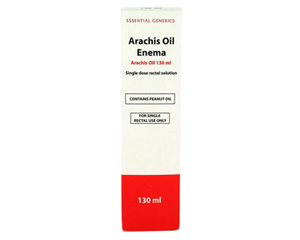
Arachis Oil
Incl. online consultation, medicine and discreet delivery
View Options
The medical information on this site is provided for educational purposes. It does not replace a face-to-face consultation with your GP or specialist. Always follow the advice of your prescribing doctor and read the patient information leaflet supplied with your medication.
Choose Your Medicine
Select dosage and quantity
Online Consultation
Reviewed by a qualified physician
Fast, Discreet Delivery
Delivered to your door
Medical Information
About This Medicine
Arachis Oil Enema is a retention enema containing refined arachis (peanut) oil, used to soften and lubricate impacted faeces in the lower bowel.
It is prescribed for the management of faecal impaction, severe constipation, and as a preparatory step before administration of other enemas or manual disimpaction.
The oil works by penetrating and softening hardened stool within the rectum and sigmoid colon, making it easier to pass.
Unlike stimulant laxatives, arachis oil does not provoke forceful peristaltic contractions; instead, it gently lubricates the bowel wall and faecal mass, allowing a more comfortable evacuation.
Faecal impaction can occur in patients who are immobile, dehydrated, taking constipating medications such as opioids, or who have neurological conditions affecting bowel motility.
In palliative care settings, arachis oil enemas are a valued tool for managing this distressing problem.
The enema is typically retained overnight to allow maximum softening of the stool, after which a phosphate or sodium citrate enema may be administered to stimulate evacuation.
In some cases, the arachis oil enema alone is sufficient to enable the patient to pass the impacted stool.
Usage & Dosage
Warm the enema to body temperature by placing the sealed container in warm water for a few minutes. Lie on your left side with knees drawn up.
Gently insert the lubricated nozzle into the rectum and slowly squeeze the contents into the bowel.
Retain the enema for as long as possible, ideally overnight. The oil needs time to soften the hardened faecal mass.
A bowel movement may follow within several hours or after a follow-up stimulant enema the next morning.
If you are administering the enema at home, wash your hands thoroughly before and after the procedure. Dispose of the used container as directed.
The standard dose is a single 130 ml enema administered rectally. It may be repeated once if clinically indicated, usually after 24 hours.
In hospital settings, the enema is often followed by a phosphate enema the next day to assist evacuation.
Use only as directed by your prescriber or healthcare team. Repeated use over multiple days should be supervised to avoid rectal irritation or electrolyte disturbance from follow-up enemas.
Side Effects
Local anal or rectal irritation may occur, including a mild burning sensation, discomfort, or a feeling of fullness. These effects are usually transient and resolve once the enema is evacuated.
Abdominal cramping may occur, particularly when the stool begins to soften and the bowel contracts to expel it.
Leakage of the oily solution onto bedding is common and can be managed with absorbent pads.
Allergic reactions are a serious concern for patients with peanut or soya allergy.
Although the oil is refined and protein content is minimal, hypersensitivity reactions, including anaphylaxis, have been reported rarely.
Report any rash, swelling, or breathing difficulty immediately.
Warnings & Precautions
Arachis oil is derived from peanuts. Patients with a known allergy to peanuts or soya must not use this product.
The risk of allergic reaction, although rare with refined oil, cannot be entirely excluded.
This enema should be used with caution in patients with inflammatory bowel disease, recent rectal surgery, or significant rectal pathology. Do not use if you suspect bowel perforation or obstruction.
Seek medical advice before use if you are pregnant, as straining to defecate may be inadvisable in certain circumstances.
Contraindications
Arachis Oil Enema is contraindicated in individuals with a known allergy to peanuts, soya, or any excipient in the product.
It must not be administered in the presence of intestinal obstruction, bowel perforation, acute inflammatory bowel disease affecting the rectum, or conditions where rectal administration is considered unsafe.
Avoid use in patients with undiagnosed abdominal pain until the cause has been established.