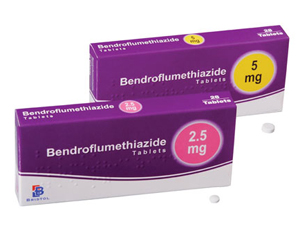
Bendroflumethiazide
Incl. online consultation, medicine and discreet delivery
View Options
The medical information on this site is provided for educational purposes. It does not replace a face-to-face consultation with your GP or specialist. Always follow the advice of your prescribing doctor and read the patient information leaflet supplied with your medication.
Choose Your Medicine
Select dosage and quantity
Online Consultation
Reviewed by a qualified physician
Fast, Discreet Delivery
Delivered to your door
Medical Information
About This Medicine
Bendroflumethiazide is a thiazide diuretic prescribed for the treatment of hypertension and oedema associated with heart failure, hepatic cirrhosis, or nephrotic syndrome.
It is one of the longest-established antihypertensive drugs and remains widely used in the United Kingdom as a first-line or add-on treatment for raised blood pressure.
Bendroflumethiazide acts on the distal convoluted tubule of the kidney, inhibiting the sodium-chloride co-transporter.
This promotes the excretion of sodium and water, reducing blood volume and consequently lowering blood pressure.
With continued use, a degree of peripheral vasodilatation also develops, contributing to the sustained antihypertensive effect even after the initial diuretic phase subsides.
At the low dose used for hypertension (2.5 mg daily), the blood pressure-lowering effect is well maintained while metabolic side effects (hypokalaemia, hyperglycaemia, hyperuricaemia) are minimised.
Higher doses produce a greater diuretic effect and are used for oedema, but the antihypertensive benefit does not proportionally increase.
Usage & Dosage
Take one tablet daily in the morning with or after breakfast. Taking it in the morning avoids the need to get up during the night to pass urine. Swallow the tablet whole with a glass of water.
Continue taking the medication even if you feel well, as hypertension rarely causes symptoms but increases the risk of stroke, heart attack, and kidney damage over time.
Do not stop taking bendroflumethiazide without consulting your doctor. Your blood pressure may rise if you discontinue it.
Attend regular blood pressure reviews and blood test appointments as directed.
For hypertension: 2.5 mg once daily in the morning.
This is usually the maximum dose for blood pressure control, as higher doses offer little additional antihypertensive benefit but increase the risk of metabolic side effects.
For oedema: 5 to 10 mg daily initially, reducing to the lowest effective maintenance dose (often 5 mg on alternate days or two to three times per week).
No dose adjustment is established for mild to moderate renal impairment; efficacy diminishes if eGFR is below 30. Thiazides are generally ineffective in severe renal impairment.
Side Effects
Common side effects (especially at higher doses) include postural hypotension (dizziness on standing), fatigue, and mild gastrointestinal disturbance.
Electrolyte imbalances are the most clinically significant concern: hypokalaemia (low potassium), hyponatraemia (low sodium), and hypomagnesaemia can develop, particularly in elderly patients.
Uncommon effects include hyperuricaemia (which may precipitate gout), impaired glucose tolerance, increased cholesterol and triglyceride levels, erectile dysfunction, rash, and photosensitivity.
Rare adverse effects include severe electrolyte depletion leading to muscle weakness, cramps, or cardiac arrhythmias; thrombocytopenia; agranulocytosis; and pancreatitis.
Seek medical attention if you experience prolonged muscle cramps, irregular heartbeat, severe weakness, or unexplained bruising or bleeding.
Warnings & Precautions
Regular monitoring of serum electrolytes (potassium, sodium, magnesium), renal function, uric acid, and blood glucose is recommended, particularly in elderly patients and those taking other medications that affect electrolytes (such as ACE inhibitors, ARBs, or potassium-sparing diuretics).
Stay well hydrated, especially in hot weather or during illness causing vomiting or diarrhoea. If you develop gout or worsening glucose control, inform your doctor.
Thiazides may worsen systemic lupus erythematosus.
Contraindications
Bendroflumethiazide is contraindicated in patients with severe renal impairment (anuria), Addison's disease (untreated adrenal insufficiency), hypercalcaemia, refractory hypokalaemia or hyponatraemia, known hypersensitivity to thiazides or sulfonamide-derived drugs, and symptomatic hyperuricaemia (gout).
Use with caution in pregnancy and breastfeeding.