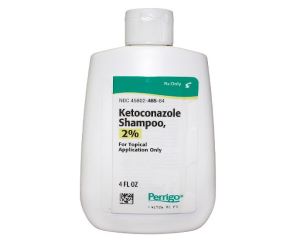
Ketoconazole Shampoo
Incl. online consultation, medicine and discreet delivery
View Options
The medical information on this site is provided for educational purposes. It does not replace a face-to-face consultation with your GP or specialist. Always follow the advice of your prescribing doctor and read the patient information leaflet supplied with your medication.
Choose Your Medicine
Select dosage and quantity
Online Consultation
Reviewed by a qualified physician
Fast, Discreet Delivery
Delivered to your door
Medical Information
About This Medicine
Ketoconazole Shampoo is a medicated antifungal shampoo used to treat and prevent dandruff, seborrhoeic dermatitis of the scalp, and pityriasis versicolor (a fungal skin infection causing discoloured patches).
It contains ketoconazole, a broad-spectrum imidazole antifungal agent.
Ketoconazole works by inhibiting the synthesis of ergosterol, a key component of fungal cell membranes. This disrupts membrane integrity and function, leading to fungal cell death.
On the scalp, it targets Malassezia species (formerly Pityrosporum), the yeasts responsible for dandruff and seborrhoeic dermatitis.
Ketoconazole shampoo is available in 1% (over-the-counter) and 2% (prescription) strengths.
The 2% formulation is more effective for established seborrhoeic dermatitis and is used both as initial treatment and for maintenance to prevent relapse.
Unlike oral ketoconazole, the shampoo formulation has negligible systemic absorption and an excellent safety profile.
Usage & Dosage
Wet hair thoroughly, apply sufficient shampoo to produce a lather covering the entire scalp, and massage gently for 3-5 minutes. This contact time is essential for the antifungal to work effectively.
Rinse thoroughly. For dandruff and seborrhoeic dermatitis: use twice weekly for 2-4 weeks for treatment, then once weekly or fortnightly for maintenance.
For pityriasis versicolor: apply to affected body areas, lather, leave for 5 minutes, and rinse. Use daily for 5 days.
Dandruff and seborrhoeic dermatitis: twice weekly for 2-4 weeks (treatment phase), then once every 1-2 weeks (maintenance). Pityriasis versicolor: once daily for up to 5 days.
Leave the shampoo in contact with the scalp or skin for 3-5 minutes before rinsing. Treatment courses can be repeated if symptoms recur.
Side Effects
Common (1 in 10 to 1 in 100): local irritation, itching, or burning sensation at the application site. Uncommon (1 in 100 to 1 in 1,000): dry skin, oily or dry hair texture changes, and folliculitis.
Rare (less than 1 in 1,000): contact dermatitis, hair discolouration (particularly in chemically treated or grey hair), and hair thinning.
Systemic side effects are extremely unlikely as absorption through the scalp is minimal at recommended usage frequencies.
Warnings & Precautions
For external use only - avoid contact with eyes. If the shampoo gets into the eyes, rinse immediately with plenty of water. Do not use on broken or inflamed skin.
Chemically treated or permed hair may be more susceptible to discolouration. Discontinue use if significant irritation develops.
Not a treatment for fungal nail infections or systemic fungal conditions.
Contraindications
Known allergy to ketoconazole, other imidazole antifungals, or any excipient in the formulation (including sodium lauryl sulphate). Not intended for oral or ophthalmic use.
Use with caution during pregnancy and breastfeeding - topical ketoconazole is generally considered safe, but consult your doctor if in doubt.