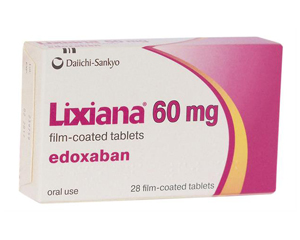
Lixiana
Incl. online consultation, medicine and discreet delivery
View Options
The medical information on this site is provided for educational purposes. It does not replace a face-to-face consultation with your GP or specialist. Always follow the advice of your prescribing doctor and read the patient information leaflet supplied with your medication.
Choose Your Medicine
Select dosage and quantity
Online Consultation
Reviewed by a qualified physician
Fast, Discreet Delivery
Delivered to your door
Medical Information
About This Medicine
Lixiana is the brand name for edoxaban, a direct oral anticoagulant (DOAC) that selectively inhibits factor Xa, a key enzyme in the coagulation cascade.
It is prescribed for the prevention of stroke and systemic embolism in adults with non-valvular atrial fibrillation, and for the treatment and prevention of recurrent deep vein thrombosis (DVT) and pulmonary embolism (PE).
Edoxaban directly and reversibly inhibits free factor Xa and prothrombinase activity without requiring antithrombin as a cofactor.
By blocking factor Xa, edoxaban reduces the generation of thrombin, which in turn diminishes fibrin clot formation.
This mechanism provides predictable anticoagulation that does not require routine monitoring of coagulation parameters.
Lixiana offers the convenience of once-daily dosing with a predictable pharmacokinetic profile.
The ENGAGE AF-TIMI 48 trial demonstrated that edoxaban was non-inferior to warfarin for the prevention of stroke in atrial fibrillation, with significantly fewer major bleeding events and a lower rate of cardiovascular death.
Usage & Dosage
Take one Lixiana tablet by mouth once daily, with or without food. Swallow whole with water. Try to take it at the same time each day.
Do not stop taking Lixiana without consulting your doctor, as this may increase the risk of blood clots or stroke.
If you miss a dose, take it as soon as you remember on the same day, then continue with your normal schedule. Do not take two doses on the same day.
The standard dose is 60 mg once daily.
A reduced dose of 30 mg once daily is used in patients with one or more of the following: moderate or severe renal impairment (creatinine clearance 15 to 50 ml/min), body weight of 60 kg or less, or concomitant use of potent P-glycoprotein inhibitors such as ciclosporin, dronedarone, erythromycin, or ketoconazole.
For venous thromboembolism, treatment is initiated after at least 5 days of initial parenteral anticoagulation.
Side Effects
Common (1 in 10 to 1 in 100): bleeding (including cutaneous, mucosal, vaginal, and urinary tract bleeding), anaemia, rash, pruritus, abnormal liver function tests, nausea.
Uncommon (1 in 100 to 1 in 1,000): intracranial haemorrhage, gastrointestinal haemorrhage, epistaxis, haemoptysis, urticaria, thrombocytopenia, elevated bilirubin.
Rare (1 in 1,000 to 1 in 10,000): allergic oedema, surgical site bleeding.
Seek immediate medical attention for signs of serious bleeding such as prolonged or uncontrolled bleeding, blood in urine or stools, or coughing up blood.
Warnings & Precautions
All anticoagulants increase the risk of bleeding.
Particular caution is needed in patients with conditions predisposing to haemorrhage, concomitant use of antiplatelet agents or other anticoagulants, and in the perioperative setting.
Lixiana should be temporarily discontinued before surgical or invasive procedures. Renal function should be assessed before starting and periodically during treatment.
In atrial fibrillation, edoxaban 60 mg should not be used in patients with a creatinine clearance above 95 ml/min, as efficacy may be reduced compared with warfarin in this population.
Switching between anticoagulants requires careful timing to maintain continuous protection.
Contraindications
Lixiana is contraindicated in patients with clinically significant active bleeding, hepatic disease associated with coagulopathy, uncontrolled severe hypertension, conditions with a major risk of haemorrhage (such as active gastrointestinal ulceration, recent brain or spinal surgery), and known hypersensitivity to edoxaban or any of the excipients.
Pregnancy and breastfeeding are contraindications.