Omacor
Incl. online consultation, medicine and discreet delivery
View Options
The medical information on this site is provided for educational purposes. It does not replace a face-to-face consultation with your GP or specialist. Always follow the advice of your prescribing doctor and read the patient information leaflet supplied with your medication.
Choose Your Medicine
Select dosage and quantity
Online Consultation
Reviewed by a qualified physician
Fast, Discreet Delivery
Delivered to your door
Medical Information
About This Medicine
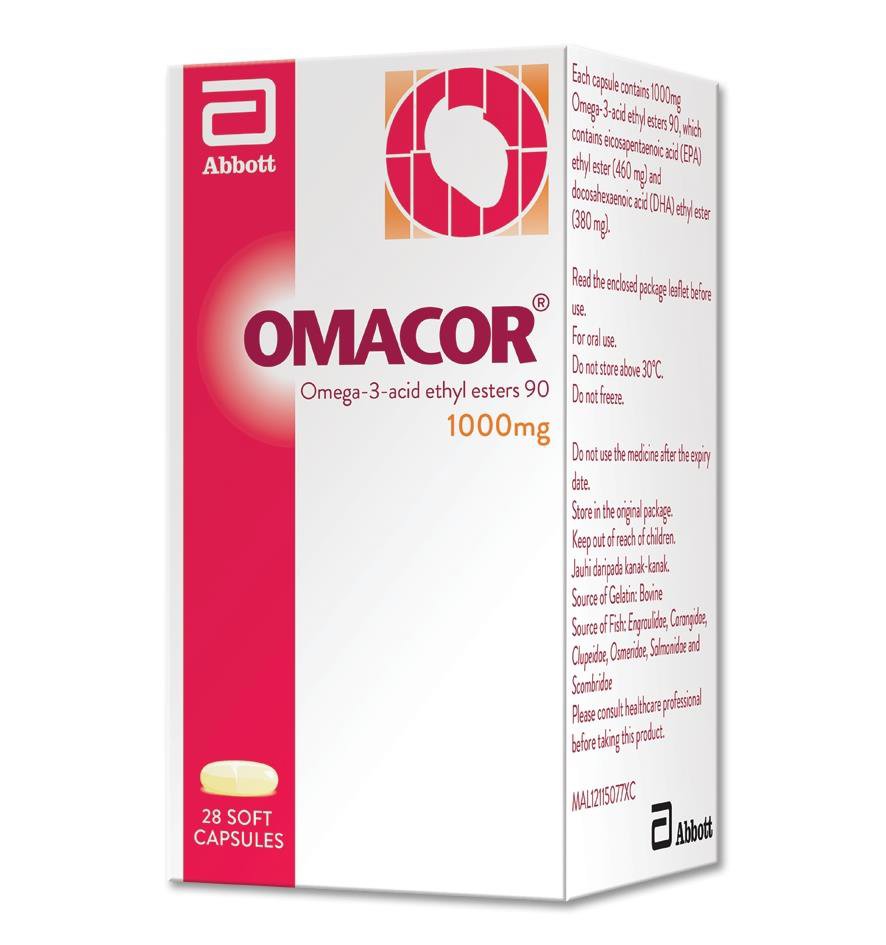
Omacor contains highly purified omega-3 polyunsaturated fatty acid ethyl esters. The main ones are eicosapentaenoic acid (EPA) and docosahexaenoic acid (DHA).
It is the only prescription omega-3 medicine licensed in the UK. Doctors prescribe it for two different conditions.
The first is hypertriglyceridaemia (type IIb/III or IV), which means very high levels of a blood fat called triglycerides.
Here it is used alongside diet when diet alone does not lower the levels enough. The second use is secondary prevention after a myocardial infarction (a heart attack).
For this, it is added to the usual medicines given after a heart attack. Omacor lowers blood fats in two ways. It cuts how much VLDL the liver makes, and it helps the body clear triglycerides faster.
(VLDL is a particle that carries fat in the blood.
) In the GISSI-Prevenzione trial, omega-3-acid ethyl esters cut all-cause death by 20% and sudden cardiac death by 45% when started within 3 months of a heart attack.
Later trials (ASCEND, VITAL, STRENGTH) studied wider groups of heart patients. Their results were smaller or less consistent.
As a result, NICE no longer advises routine omega-3 supplements for heart disease prevention in all patients. Omacor stays licensed for its specific uses.
A doctor may still prescribe it when their clinical judgement supports it.
Usage & Dosage
Swallow the capsules whole with water during or after meals. Do not pierce or chew them. For hypertriglyceridaemia, the usual dose is 2 capsules twice daily with food.
If the response is not enough after 2 months, this can be raised to 4 capsules twice daily under specialist care. For secondary prevention after a heart attack, the dose is 1 capsule once daily.
The doctor should check how well it works after 2 months by measuring your fasting triglyceride levels. If you take it for hypertriglyceridaemia, keep up your dietary measures during treatment.
This means less alcohol, sugar, and saturated fat. Regular checks of liver function and LDL cholesterol are wise. Omega-3 acids can raise LDL levels while they lower triglycerides.
Hypertriglyceridaemia: Start with 2 capsules (2 g) daily. Raise this to 4 capsules (4 g) daily if triglycerides have not dropped enough after 2 months. Take in divided doses with food.
Post-myocardial infarction: 1 capsule (1 g) once daily, taken with food.
There is no dose change needed for poor kidney function. If you have poor liver function, use Omacor with caution, because it may affect how the liver handles fats. Liver function should be monitored.
There is no specific dose change for older patients. The doctor should reassess how well treatment is working on a regular basis.
Side Effects
Side effects are listed by SmPC frequency category.
Common (≥1/100 to <1/10): Indigestion (dyspepsia), nausea, tummy pain, fishy burps (eructation), diarrhoea, and a bloated tummy.
Uncommon (≥1/1,000 to <1/100): High blood sugar (hyperglycaemia), dizziness, a change in taste, headache, vomiting, gastroenteritis, rash, acne, raised liver transaminases (a sign of liver strain), and raised LDL cholesterol.
Rare (≥1/10,000 to <1/1,000): Low blood pressure (hypotension), nosebleeds (epistaxis), bleeding in the gut, a liver disorder, and hives (urticaria).
Very rare (<1/10,000): Blood in the urine (haematuria).
The most common nuisance side effect is fishy burps. You can reduce these by taking the capsules with food or by freezing them before you swallow them.
LDL cholesterol may go up during treatment for hypertriglyceridaemia. Some patients then need a statin as well.
Warnings & Precautions
Monitor LDL cholesterol during treatment for hypertriglyceridaemia. It can rise unexpectedly, and you may then need a statin as well.
Monitor liver function too, mainly at the higher doses used for hypertriglyceridaemia. Omega-3 acids have a mild effect on platelets, the cells that help blood clot.
Take care in patients on anticoagulants (warfarin, DOACs) or antiplatelet medicines (aspirin, clopidogrel), because the time it takes blood to clot may get longer.
At standard doses this interaction usually matters little, but watch for any signs of bleeding. People with a known fish allergy should not take Omacor. The active ingredients come from fish oil.
The GISSI-Prevenzione trial results may not fully apply to practice today, where almost everyone already takes a statin and a RAAS inhibitor.
Contraindications
Do not take Omacor if you are hypersensitive to omega-3-acid ethyl esters, soya, peanut, or any other ingredient. The capsules contain soya lecithin.
It should not be used for exogenous hypertriglyceridaemia (type I hyperlipoproteinaemia). Use with caution in severe liver impairment, because there is not enough safety data.