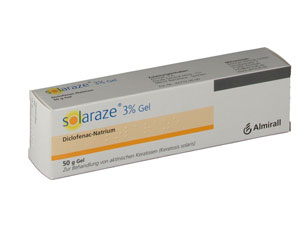
Solaraze
Incl. online consultation, medicine and discreet delivery
View Options
The medical information on this site is provided for educational purposes. It does not replace a face-to-face consultation with your GP or specialist. Always follow the advice of your prescribing doctor and read the patient information leaflet supplied with your medication.
Choose Your Medicine
Select dosage and quantity
Online Consultation
Reviewed by a qualified physician
Fast, Discreet Delivery
Delivered to your door
Medical Information
About This Medicine
Solaraze Gel contains diclofenac sodium in a topical gel formulation, specifically licensed for the treatment of actinic keratoses (solar keratoses).
Actinic keratoses are rough, scaly patches on sun-damaged skin that are considered pre-malignant, with a small risk of progressing to squamous cell carcinoma if left untreated.
Diclofenac is a non-steroidal anti-inflammatory drug (NSAID) that inhibits cyclooxygenase (COX) enzymes, reducing the production of prostaglandins.
In the context of actinic keratoses, this anti-inflammatory and possibly anti-proliferative action helps to resolve the abnormal epidermal cells.
The gel also contains hyaluronic acid, which acts as a carrier to enhance skin penetration and local retention of diclofenac.
Solaraze Gel offers a non-invasive treatment alternative to cryotherapy, curettage, or other topical agents such as fluorouracil.
It is particularly suitable for patients with multiple, widespread actinic keratoses where procedural treatments would be impractical, and for those who prefer a topical approach.
Treatment with Solaraze Gel typically spans 60 to 90 days.
The response rate varies, but clinical trials demonstrate complete clearance in approximately 30 to 50 per cent of treated lesions, with a further proportion showing partial resolution.
Usage & Dosage
Apply a thin layer of Solaraze Gel to the affected area twice daily, smoothing it gently over the lesion and the surrounding skin.
Do not apply to open wounds, infected skin, or areas near the eyes or mucous membranes.
Wash your hands after application unless the hands are the treatment area. Allow the gel to dry before covering the site with clothing.
Do not apply occlusive dressings over treated areas unless instructed by your dermatologist.
Complete the full 60- to 90-day course as prescribed. Stopping early may reduce the likelihood of clearing the lesion.
The clinical response is often delayed and continues to develop after the treatment course ends.
Apply approximately 0.5 g of gel (roughly the size of a pea) to each 5 cm by 5 cm lesion area twice daily. The total daily dose should not exceed 8 g. Treatment duration is 60 to 90 days.
Do not apply more gel than recommended. If multiple lesions are being treated simultaneously, ensure the total application remains within the daily limit.
Response should be assessed approximately 30 days after completing the course.
Side Effects
Local skin reactions at the application site are very common, affecting more than 10 per cent of users.
These include redness (erythema), itching, dryness, scaling, and a burning or tingling sensation.
Some degree of local irritation is expected and may indicate the drug is acting on the abnormal cells.
Contact dermatitis occurs in a smaller proportion of patients. Less commonly, patients may develop blistering, crusting, or erosion at the treated site.
Systemic absorption of diclofenac from the gel is minimal.
However, in patients applying the gel to large areas, systemic NSAID side effects such as gastrointestinal disturbance, headache, and dizziness are theoretically possible.
Photosensitivity reactions have been reported. Protect treated areas from direct sunlight during and after treatment.
Warnings & Precautions
Avoid sun exposure to treated areas during the course of treatment. Solaraze Gel may increase photosensitivity, and UV exposure can worsen actinic keratoses.
Apply sunscreen and wear protective clothing when outdoors.
Do not use Solaraze Gel on or near the eyes, lips, or mucous membranes. If severe local reactions develop, such as extensive blistering or weeping, interrupt treatment and consult your dermatologist.
Inform your prescriber if you have a history of NSAID-related asthma, gastrointestinal bleeding, or renal impairment. Although systemic absorption is low, caution is advisable in these groups.
Contraindications
Solaraze Gel is contraindicated in patients with known hypersensitivity to diclofenac, other NSAIDs, or any excipient in the gel.
It must not be used by patients in whom aspirin or other NSAIDs have previously triggered asthma, urticaria, or acute rhinitis.
Do not apply to open wounds, active skin infections, or severely inflamed or exudative dermatoses. Avoid use during the third trimester of pregnancy.