Competact
Incl. online consultation, medicine and discreet delivery
View Options
The medical information on this site is provided for educational purposes. It does not replace a face-to-face consultation with your GP or specialist. Always follow the advice of your prescribing doctor and read the patient information leaflet supplied with your medication.
Choose Your Medicine
Select dosage and quantity
Online Consultation
Reviewed by a qualified physician
Fast, Discreet Delivery
Delivered to your door
Medical Information
About This Medicine
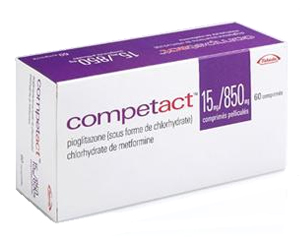
Competact is a single tablet that combines two diabetes medicines: pioglitazone and metformin hydrochloride. It treats type 2 diabetes.
Doctors prescribe it when metformin on its own does not control blood sugar well enough.
Your doctor will also check that adding a thiazolidinedione, the drug group pioglitazone belongs to, is right for you.
Pioglitazone is an insulin sensitiser. It works on a receptor in your cells called PPAR-gamma (peroxisome proliferator-activated receptor-gamma).
This helps your muscle, fat, and liver respond better to your own insulin. In other words, it lowers insulin resistance, which is a key problem in type 2 diabetes. Metformin works in a different way.
It lowers the amount of sugar your liver makes and helps your body take up more sugar.
Having both medicines in one tablet makes treatment simpler. It can be easier to stick with than taking two separate tablets. Competact does not make your body release more insulin.
Because of this, it carries a low risk of low blood sugar (hypoglycaemia) on its own, as long as you do not also take a sulphonylurea or insulin.
Use Competact alongside a healthy diet, regular exercise, and weight control. It does not replace these changes. It works with them to keep your blood sugar in check.
Usage & Dosage
Take one tablet twice a day, with or just after meals. Taking it with food reduces stomach upset from the metformin part. Swallow the tablet whole with water.
Keep taking Competact as prescribed, even when you feel well. High blood sugar often causes no symptoms.
Check your blood sugar regularly, as your diabetes team advises. Tell your prescriber if you gain weight you cannot explain, your ankles swell, or you feel breathless.
These signs may mean your body is holding on to fluid.
Do not stop taking Competact without medical advice. If you forget a dose, take it as soon as you remember, with your next meal. Do not take a double dose to make up for the one you missed.
Competact comes as 15 mg/850 mg tablets. This means each tablet has 15 mg of pioglitazone and 850 mg of metformin. The usual dose is one tablet twice a day.
With this combination, the most pioglitazone you can take in a day is 30 mg, and the most metformin is 1,700 mg.
Your doctor will set your dose to match the metformin dose you already take. They should check how well your kidneys work before you start, and at least once a year after that.
Competact is not suitable if your eGFR, a measure of kidney function, is below 30 mL/min.
Side Effects
Weight gain is common with pioglitazone. You may put on 2 to 4 kg in the first year of treatment. Fluid build-up can cause swollen ankles (peripheral oedema).
This happens in about 5 to 10 per cent of people. It is more likely when pioglitazone is taken with insulin.
Metformin can upset your stomach. You may feel sick, have diarrhoea, get stomach pain, or notice a metallic taste.
These effects usually ease off as you keep taking it and as the dose is raised slowly.
Pioglitazone slightly raises the risk of broken bones, mainly in women.
Studies that track large groups of people have also linked it to a higher rate of bladder cancer, though the overall risk stays low.
In rare cases, the metformin part can cause lactic acidosis, a build-up of acid in the blood. This is more likely if your kidneys work poorly, you are dehydrated, or you drink too much alcohol.
Pioglitazone has also been linked to changes in liver function.
Warnings & Precautions
Do not use Competact if you have heart failure now, or have had it in the past (NYHA class I to IV). Pioglitazone can cause or worsen fluid build-up.
Get medical help if you become breathless, gain weight quickly, or your ankles swell.
Do not take pioglitazone if you have bladder cancer now, have had it before, or have blood in your urine that has not been checked.
Your doctor should test your liver before you start and from time to time during treatment.
Stop Competact for a short time before any scan that uses iodine-based contrast dye. Also stop it during any illness that makes you dehydrated. Both steps lower the risk of lactic acidosis.
Contraindications
Do not take Competact if you have heart failure of any kind (any NYHA class), diabetic ketoacidosis, liver problems, or severe kidney problems (eGFR below 30 mL/min).
Also avoid it if you have bladder cancer now or have had it before, or if you are allergic to pioglitazone, metformin, or any other ingredient.
Do not use it for type 1 diabetes. The metformin part can rarely cause lactic acidosis, which is serious.
This risk is higher if you have kidney failure, a severe infection (sepsis), or low oxygen in your tissues.