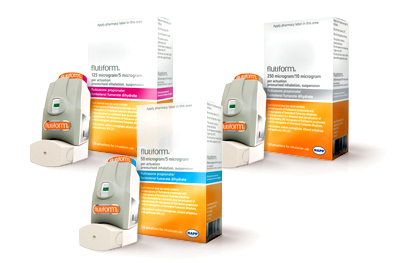
Flutiform
Incl. online consultation, medicine and discreet delivery
View Options
The medical information on this site is provided for educational purposes. It does not replace a face-to-face consultation with your GP or specialist. Always follow the advice of your prescribing doctor and read the patient information leaflet supplied with your medication.
Choose Your Medicine
Select dosage and quantity
Online Consultation
Reviewed by a qualified physician
Fast, Discreet Delivery
Delivered to your door
Medical Information
About This Medicine
Flutiform is a combination inhaler containing fluticasone propionate (an inhaled corticosteroid) and formoterol fumarate (a long-acting beta-2 agonist, or LABA).
It is used for the regular treatment of asthma in patients who require both an inhaled corticosteroid and a long-acting bronchodilator for adequate symptom control.
Fluticasone propionate reduces airway inflammation, oedema, and mucus production, addressing the underlying inflammatory component of asthma.
Formoterol provides rapid-onset bronchodilation (within 1-3 minutes) with a sustained effect lasting 12 hours, relieving bronchoconstriction and improving airflow.
The combination of these two agents in a single inhaler simplifies treatment and improves adherence.
Flutiform is delivered via a pressurised metered-dose inhaler (pMDI) and is available in three strengths to allow appropriate dose titration.
It should be used regularly twice daily as a preventer and must not be used as a rescue inhaler for acute bronchospasm.
Usage & Dosage
Shake the inhaler well before each use. Take two puffs twice daily (morning and evening), approximately 12 hours apart.
Use a spacer device if recommended by your doctor or if your technique needs improvement. Rinse your mouth with water and spit out after each use to reduce the risk of oral thrush and hoarseness.
Always carry a separate short-acting reliever inhaler (such as salbutamol) for breakthrough symptoms.
Adults and adolescents 12 years and over: 2 inhalations twice daily. Starting strength depends on asthma severity: mild-moderate 50/5, moderate 125/5, moderate-severe 250/10 micrograms per actuation.
Maximum recommended dose: 2 puffs of 250/10 twice daily. Step down to the lowest strength that maintains control. Children under 12: not recommended.
Side Effects
Common (1 in 10 to 1 in 100): oral candidiasis (thrush), hoarseness, headache, tremor, and palpitations. Uncommon (1 in 100 to 1 in 1,000): cough, nausea, muscle cramps, tachycardia, and hypokalaemia.
Rare (less than 1 in 1,000): adrenal suppression (at high doses), paradoxical bronchospasm, growth retardation in children, reduced bone mineral density, cataracts, and glaucoma.
Local side effects from the corticosteroid component (thrush and hoarseness) can be minimised by mouth rinsing and using a spacer.
Warnings & Precautions
Not for acute relief of bronchospasm - always carry a separate reliever inhaler. Do not stop suddenly, particularly if on higher doses, as adrenal insufficiency may occur.
If asthma worsens despite treatment, seek medical review. Monitor growth in children and adolescents.
Patients transferring from oral corticosteroids require careful monitoring for adrenal insufficiency. Systemic effects of the inhaled corticosteroid are possible at high doses.
Contraindications
Known allergy to fluticasone propionate, formoterol, or any excipient. Active pulmonary tuberculosis. Untreated fungal, bacterial, or viral respiratory infections.
Not suitable for the treatment of acute asthma attacks or status asthmaticus.