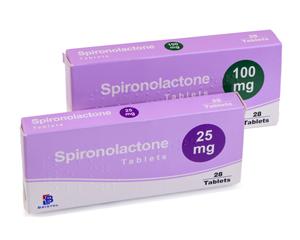
Spironolactone
Incl. online consultation, medicine and discreet delivery
View Options
The medical information on this site has been reviewed by Dr. Ross Elledge (GMC registered) and is provided for educational purposes. It does not replace a face-to-face consultation with your GP or specialist. Always follow the advice of your prescribing doctor and read the patient information leaflet supplied with your medication.
Choose Your Medicine
Select dosage and quantity
Online Consultation
Reviewed by a qualified physician
Fast, Discreet Delivery
Delivered to your door
Medical Information
About This Medicine
Spironolactone is a potassium-sparing diuretic and aldosterone antagonist used in the management of heart failure, resistant hypertension, primary hyperaldosteronism, hepatic cirrhosis with ascites, and nephrotic syndrome.
It is also widely prescribed off-label for the treatment of hormonal acne, hirsutism, and androgenetic alopecia in women due to its anti-androgenic properties.
Spironolactone works by competitively blocking aldosterone receptors in the distal convoluted tubule and collecting duct of the kidney.
Aldosterone normally promotes sodium reabsorption and potassium excretion; by antagonising its effects, spironolactone increases sodium and water excretion while conserving potassium.
This mechanism makes it particularly useful in conditions characterised by secondary hyperaldosteronism, such as heart failure and cirrhosis.
In heart failure, spironolactone has been shown to reduce mortality and hospitalisation when added to standard therapy.
The landmark RALES trial demonstrated a 30% reduction in all-cause mortality in patients with severe heart failure treated with spironolactone, establishing it as a cornerstone of heart failure management.
Usage & Dosage
Take spironolactone with or after food to improve absorption and reduce gastrointestinal upset. Swallow the tablets whole with a glass of water. Take it at the same time each day.
If you are prescribed a once-daily dose, take it in the morning to reduce the likelihood of needing to pass urine during the night.
If taking a twice-daily dose, take the second dose no later than early afternoon. Do not stop treatment suddenly without consulting your prescriber.
For heart failure: 25 mg once daily, which may be increased to 50 mg once daily if tolerated and clinically indicated. For resistant hypertension: 25 mg once daily initially.
For hepatic cirrhosis with ascites: 100 to 400 mg daily in divided doses. For primary hyperaldosteronism: 100 to 400 mg daily. For acne and hirsutism (off-label): 50 to 200 mg daily.
Dose adjustments are necessary in renal impairment, and serum potassium must be monitored closely.
Side Effects
Very common (more than 1 in 10): hyperkalaemia (particularly in patients with renal impairment or those taking other potassium-elevating agents).
Common (1 in 10 to 1 in 100): nausea, diarrhoea, gynaecomastia and breast tenderness (in men), menstrual irregularity (in women), fatigue, headache, dizziness, leg cramps.
Uncommon (1 in 100 to 1 in 1,000): impotence, deepening of voice, skin rash, drowsiness, hyponatraemia.
Rare (1 in 1,000 to 1 in 10,000): agranulocytosis, Stevens-Johnson syndrome, hepatotoxicity. Gynaecomastia is dose-related and usually reversible upon discontinuation.
Warnings & Precautions
Regular monitoring of serum potassium and renal function is essential, particularly during initiation, dose changes, and in patients at higher risk of hyperkalaemia.
Do not use potassium supplements or potassium-containing salt substitutes without medical advice. Spironolactone may cause gynaecomastia in men and menstrual irregularity in women.
Use with caution in patients with renal impairment, hepatic impairment, or Addison's disease. Drowsiness may occur, so exercise caution when driving or operating machinery.
Contraindications
Spironolactone is contraindicated in patients with Addison's disease, hyperkalaemia, severe renal impairment (estimated GFR below 10 ml/min), anuria, and hypersensitivity to spironolactone or any excipient.
Concurrent use with eplerenone is contraindicated. Use with caution and close monitoring when co-prescribed with ACE inhibitors or ARBs.
Frequently Asked Questions
Why does spironolactone cause breast tenderness in men?
Can I eat foods high in potassium while taking spironolactone?
How long does spironolactone take to work for acne?
Is spironolactone safe during pregnancy?
Can I drink alcohol while taking spironolactone?
Related articles: Spironolactone
Dr. Ross Elledge
Consultant Surgeon · Oral & Maxillofacial Surgery
Verified Healthcare Professional