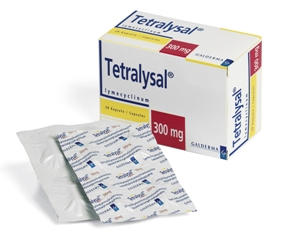
Lymecycline
Incl. online consultation, medicine and discreet delivery
View Options
The medical information on this site is provided for educational purposes. It does not replace a face-to-face consultation with your GP or specialist. Always follow the advice of your prescribing doctor and read the patient information leaflet supplied with your medication.
Choose Your Medicine
Select dosage and quantity
Online Consultation
Reviewed by a qualified physician
Fast, Discreet Delivery
Delivered to your door
Medical Information
About This Medicine
Tetralysal contains lymecycline, a tetracycline antibiotic prescribed primarily for the treatment of acne vulgaris. It is also effective against other susceptible bacterial infections.
Lymecycline is a well-established oral antibiotic for moderate inflammatory acne that has not responded to topical treatments alone.
Lymecycline is a prodrug that is rapidly hydrolysed in the body to tetracycline, which exerts its antibacterial effect by inhibiting bacterial protein synthesis.
It binds to the 30S ribosomal subunit of susceptible bacteria, preventing the attachment of aminoacyl-transfer RNA and halting the growth of bacteria.
In acne, its primary target is Cutibacterium acnes (formerly Propionibacterium acnes), the bacterium that drives the inflammatory component of the disease.
Beyond its direct antibacterial action, tetracyclines also possess anti-inflammatory properties.
They inhibit matrix metalloproteinases and reduce neutrophil chemotaxis, which contributes to the reduction of redness and swelling in inflammatory acne lesions.
Treatment courses for acne typically last eight to twelve weeks.
Usage & Dosage
Take one Tetralysal capsule daily by mouth, ideally in the morning. Swallow the capsule whole with a full glass of water while sitting or standing upright.
Do not take it with milk, antacids, iron supplements, or calcium supplements, as these reduce absorption.
Taking it on an empty stomach improves absorption, but it may be taken with a light meal if nausea occurs.
Continue the full course of treatment as prescribed, even if your skin starts to improve. Improvement in acne is gradual and usually becomes apparent after six to eight weeks.
Do not exceed the recommended dose. Use sunscreen and avoid excessive sun exposure, as tetracyclines increase photosensitivity.
For acne: one 408 mg capsule once daily, usually for a minimum of eight weeks. Some patients may be treated for up to twelve weeks.
For other infections: one 408 mg capsule once or twice daily, depending on the severity of the infection and clinical response.
No dose adjustment is specified for mild renal impairment, but tetracyclines should be avoided in significant renal impairment due to the risk of accumulation.
Not recommended in severe hepatic impairment.
Side Effects
Common side effects include nausea, diarrhoea, abdominal discomfort, and headache.
Photosensitivity (increased susceptibility to sunburn) is a well-recognised effect of tetracyclines; use a broad-spectrum sunscreen and limit sun exposure.
Uncommon effects include oesophageal ulceration (particularly if the capsule is taken without sufficient water or while lying down), vaginal candidiasis (thrush), dizziness, and skin rash.
Rare but serious effects include benign intracranial hypertension (pseudotumour cerebri), characterised by severe headache, visual disturbance, and papilloedema.
Hepatotoxicity and severe allergic reactions have been reported very rarely. If you develop a persistent severe headache or visual changes, stop the medication and seek urgent medical review.
Warnings & Precautions
Take Tetralysal with a full glass of water and remain upright for at least 30 minutes afterwards to reduce the risk of oesophageal irritation.
Avoid excessive sun or UV exposure and use a high-factor sunscreen, as photosensitivity reactions can be severe.
Tetracyclines should not be taken during pregnancy as they can affect fetal bone and tooth development, and they are not suitable for children under 12.
They may reduce the efficacy of oral contraceptives; although evidence for this is debated, using additional precautions during the first cycle is prudent.
Contraindications
Tetralysal is contraindicated in patients with known hypersensitivity to lymecycline, other tetracyclines, or any excipient.
It must not be used in pregnancy, during breastfeeding, or in children under 12 years of age.
Significant renal impairment and concurrent treatment with retinoids (such as isotretinoin) are also contraindications, the latter due to the combined risk of benign intracranial hypertension.